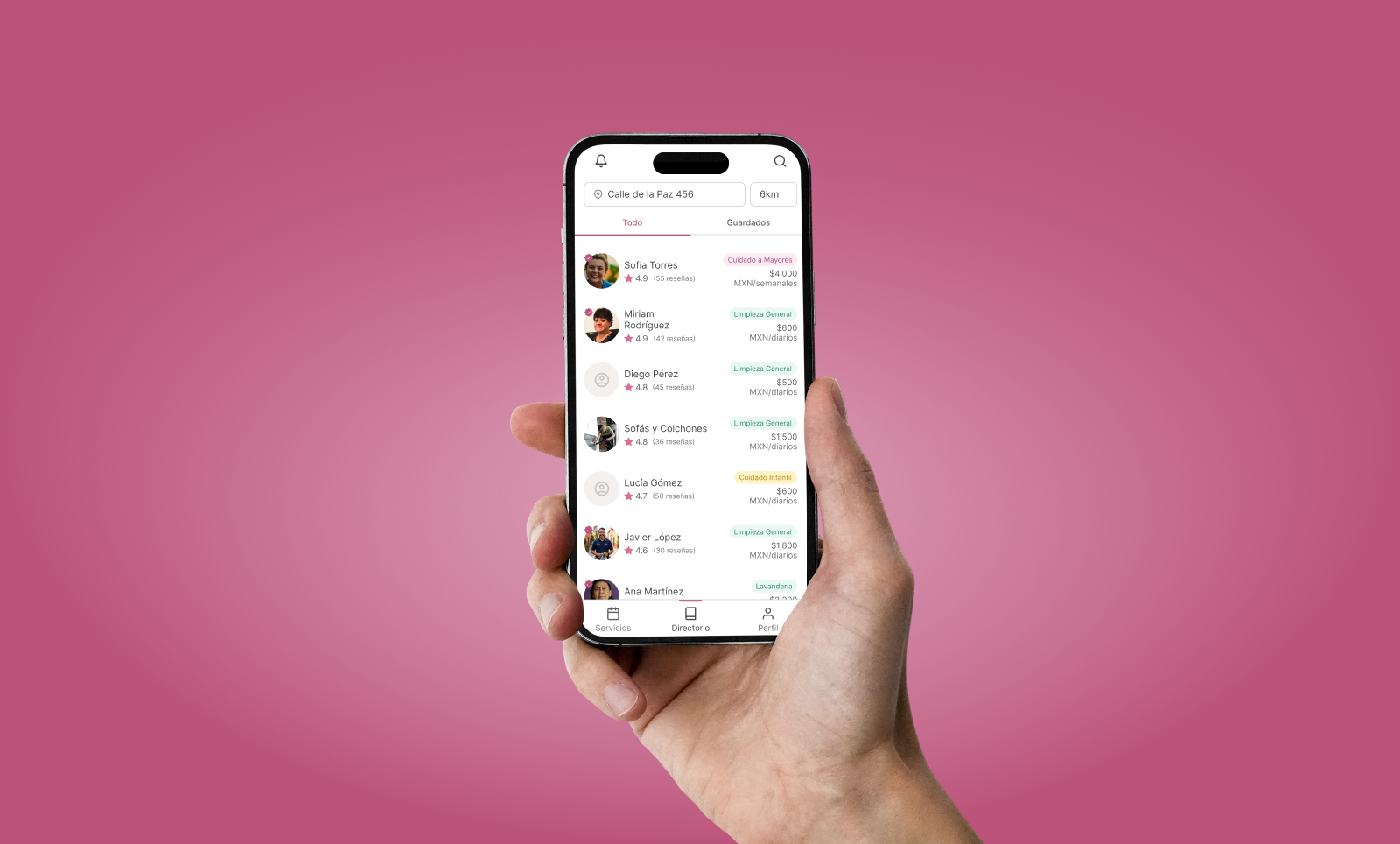
Finding qualified domestic staff is often a deeply personal process. Families typically rely on recommendations from friends, social media groups, or local agencies, while experienced workers depend heavily on word-of-mouth to find new opportunities.
Domestic Employment App was conceived as an early-stage startup focused on modernizing household recruitment in Mexico. The platform aimed to connect families seeking long-term domestic support with verified professionals, including housekeepers, cooks, caregivers, nurses, and other household staff.
Rather than functioning as a traditional job board, the product sought to create a structured and trustworthy hiring experience for both employers and workers.
The project remained within the MVP stage throughout its lifecycle. While core user journeys were designed and validated, several ideas and features remained in exploration as the team focused on testing the platform's fundamental assumptions before expanding its scope.
Domestic employment presents challenges that differ significantly from traditional recruiting platforms.
Hiring decisions often involve access to private homes, long-term working relationships, and a strong emotional component. Trust becomes just as important as qualifications.
Initial conversations with stakeholders revealed a fragmented hiring ecosystem where employers struggled to verify candidates and workers had limited ways to present themselves professionally beyond informal recommendations.
The project faced three primary challenges:
Employers approached the hiring process cautiously. Their primary concerns centered around reliability, safety, experience, and compatibility.
Domestic professionals approached the platform from a different perspective. They needed visibility, credibility, and access to opportunities that often remained hidden within private referral networks.
The challenge was creating a product that felt valuable and safe for both sides without overwhelming either audience.
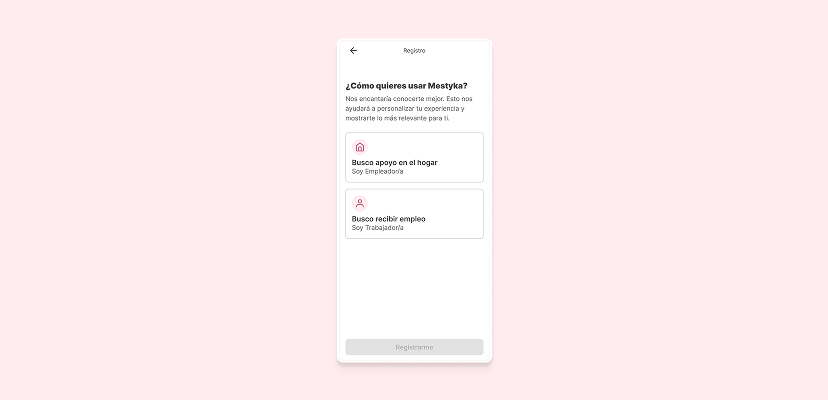
Early in the project, it became clear that trust wasn't simply a feature to be added later. It was the foundation of the entire experience.
Every design decision was evaluated through a simple question:
How can interaction increase confidence between employers and workers?
This principle influenced onboarding, profile design, communication flows, and even future roadmap discussions.
One of the most valuable discoveries emerged during conversations with potential domestic workers.
Many participants had years, or even decades, of professional experience but limited familiarity with digital platforms. While smartphone usage was common, advanced onboarding processes created hesitation.
Several participants expressed concerns about sharing personal information online. One recurring comment was:
"If I upload my photo, someone could steal my information."
This insight challenged one of our earliest assumptions.
Initially, identity verification was envisioned as a mandatory onboarding requirement. However, making verification compulsory risked creating significant abandonment before users could experience any value from the platform.
The problem was no longer just about security. It became a question of accessibility and trust in technology itself.
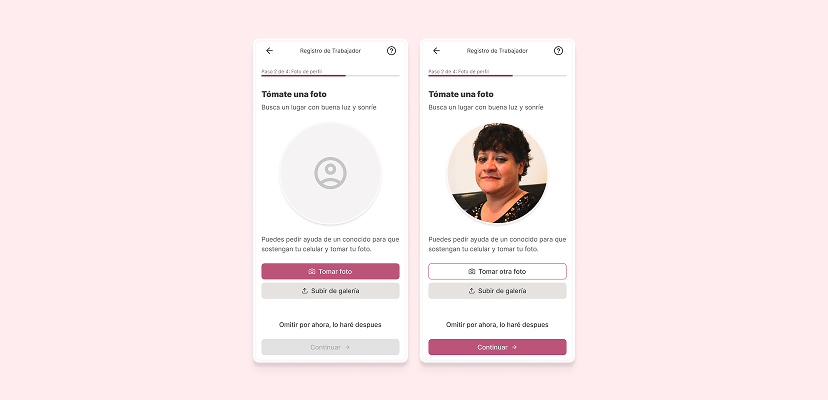
Rather than requiring full verification during registration, the onboarding experience was redesigned to reduce friction.
Users could create an account, explore opportunities, and begin building their profile without immediately submitting documentation.
Verification became an optional but highly visible trust signal.
Domestic professionals could progressively complete additional verification steps, including:
Instead of blocking access, verification became an incentive.
More complete profiles appeared more trustworthy, increasing their likelihood of attracting employer interest and receiving stronger opportunities.
This approach balanced two competing goals: encouraging platform adoption while still providing meaningful credibility indicators.
The team also analyzed key moments where uncertainty typically appeared during hiring. Several recurring concerns emerged:
These questions highlighted opportunities to create transparency throughout the experience and informed many of the product's core workflows.
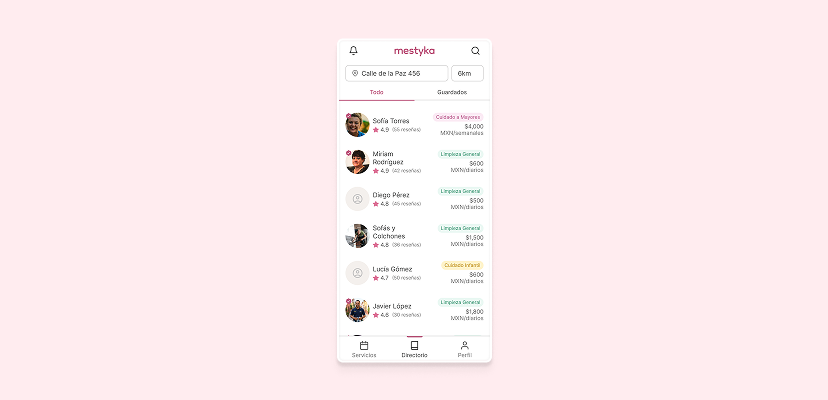
Traditional job listings often reduce people to short descriptions and limited information. For this project, profiles became the primary decision-making tool.
Workers were able to present professional experience, skills, availability, and verification status in a structured format designed to support trust and credibility.
The goal was to help employers evaluate potential candidates before initiating conversations.
Privacy concerns existed on both sides of the marketplace. Employers wanted protection from unwanted contact, while workers needed confidence that conversations were legitimate before sharing personal information.
The MVP explored a staged communication model that allowed users to express interest, send opportunities, review offers, and exchange messages within the platform before progressing further. This approach created a more controlled environment while maintaining a natural hiring process.
Research revealed that uncertainty was a common frustration throughout the hiring journey. Many users were accustomed to sending applications or inquiries without ever receiving updates. To address this issue, the experience introduced clear status indicators throughout the hiring flow, helping users understand whether opportunities were pending, accepted, declined, or still awaiting a response.
The objective was simple: reduce ambiguity and increase confidence in the process.
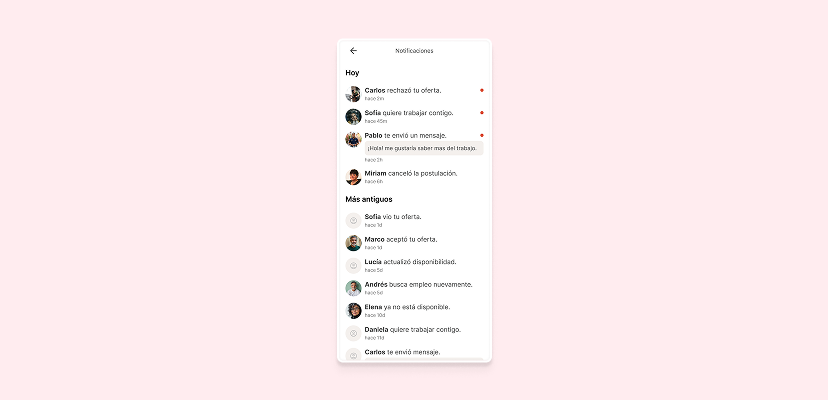
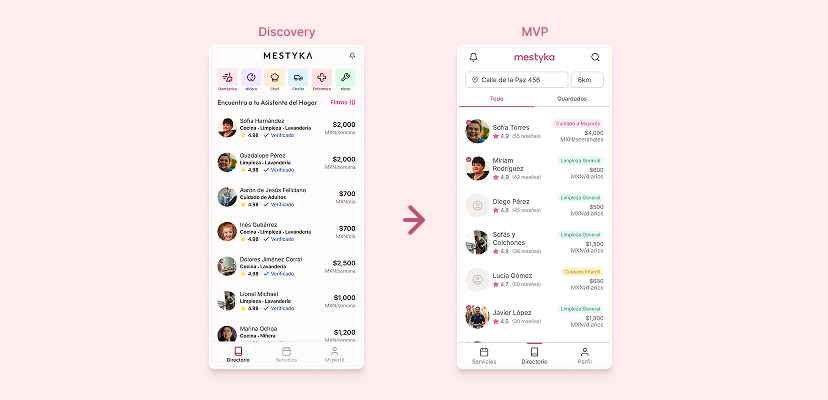
The target audience heavily influenced platform decisions. Many domestic professionals relied primarily on mobile devices for internet access, making mobile usability a critical requirement rather than a secondary consideration. Information architecture, navigation patterns, and content prioritization were designed around smaller screens from the beginning. This ensured that essential actions remained accessible even for users with limited digital experience.
A significant design objective was moving away from the appearance of classified ads or informal social media listings. The visual language focused on creating a sense of legitimacy and professionalism while remaining approachable.
Profile presentation, verification indicators, content hierarchy, and interaction patterns all contributed to reinforcing credibility throughout the experience.
The resulting MVP established a foundation for a more structured and transparent domestic hiring experience.
Rather than attempting to solve every aspect of household recruitment, the project focused on validating core assumptions around trust, profile credibility, and employer-worker interactions.
The design demonstrated how marketplace experiences can address emotional concerns alongside functional requirements.
As an early-stage product, not every idea progressed beyond exploration. The team deliberately prioritized the experiences most critical to validating the business model, including onboarding, profile creation, discovery, and communication.
Several concepts remained in early analysis stages, including more advanced reputation systems, expanded verification workflows, and additional hiring management tools. This constraint became an important design exercise in prioritization.
The challenge was not designing everything—it was identifying what needed to exist for the first version to generate meaningful learning.
This project reinforced an important lesson about marketplace design: Trust cannot be added through a single feature.
It emerges from a series of small decisions that reduce uncertainty, create transparency, and respect the realities of the people using the product. For Domestic Employment App, the most valuable insight was recognizing that building confidence in the platform itself was just as important as helping users trust one another. In an industry historically driven by personal referrals and informal networks, creating digital trust became the real design challenge.
This project was build under LKMX Software Development managemente. See more of their projects.
